
A new case study documents how a group of nine organizations is turning weak enforcement into real deterrence, and giving vultures and other wildlife a fighting chance.
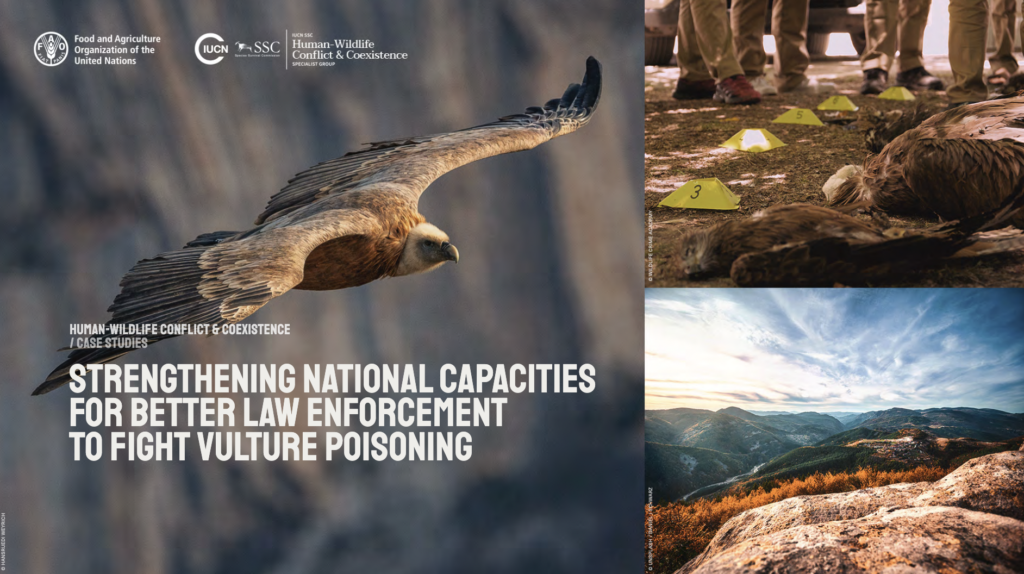
It starts with a piece of meat or even a whole carcass, laced and left in a field. Despite being illegal in every country in the region, the deliberate laying of poison baits remains widespread and deeply embedded across the Balkan Peninsula, a practice with roots going back centuries, and one that until the 1970s was not only tolerated but actively encouraged by governments seeking to eliminate predators. That legacy still shapes attitudes on the ground today.
The most common trigger is conflict: a farmer loses a lamb, a hunter blames a predator, and the response is poison baits in the field. But poison doesn’t discriminate. Everything that feeds on that carcass, or on the animals that fed on it, becomes a casualty.
Vultures suffer disproportionately. As obligate scavengers ecologically dependent on dead animals for food, they are almost inevitably victims whenever a poisoning event occurs in their territory. Between 2000 and 2020, at least 468 vultures were recorded dead from illegal poisoning across the region. But since only up to 20 per cent of incidents are ever discovered, the true estimated toll reaches around 2,300 birds over those two decades. Species have been lost entirely: the Bearded Vulture disappeared from continental Greece in 2004 and North Macedonia in 2006; the Griffon Vulture from Bosnia and Herzegovina in 1991; the Egyptian Vulture from Serbia in 2005.
Wildlife poisoning is already illegal across the region. The crisis is not so much a legislative failure; it is an enforcement one.

Why enforcement has failed
A newly published case study by the Food and Agriculture Organization of the United Nations and the IUCN SSC Human-Wildlife Conflict & Coexistence Specialist Group lays out the problem plainly. Unclear jurisdictions, absent standardized procedures, undertrained field officers, and toxicology laboratories lacking the capacity to process wildlife samples have all combined to create a system where fewer than 1 per cent of poisoning cases ever reach a court trial. When accountability is essentially nonexistent, poisoning remains a low-risk choice for those in conflict with wildlife.
That is what the BalkanDetox LIFE project, led by the Vulture Conservation Foundation (VCF) and co-funded by the EU’s LIFE Programme, set out to change, not through awareness campaigns alone, but by rebuilding the institutional capacity to actually enforce the law.
What the project did
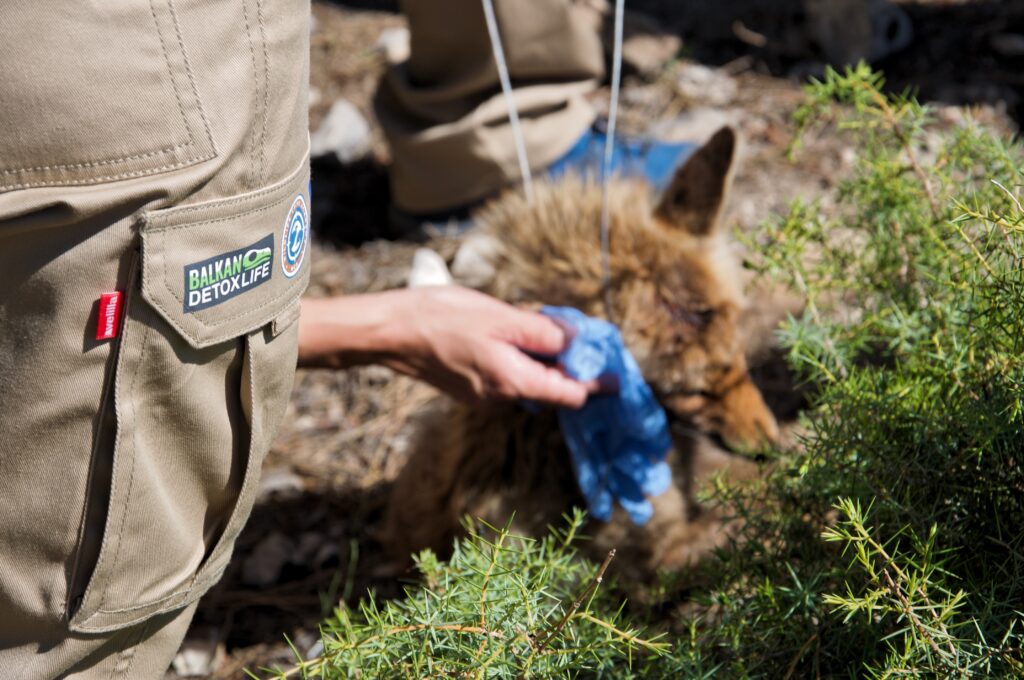
Working across Albania, Bosnia and Herzegovina, Bulgaria, Croatia, Greece, North Macedonia and Serbia, nine organizations established national anti-poisoning working groups that brought together police, veterinary services, forestry rangers, prosecutors and toxicologists. Rather than imposing solutions, the project identified problems and built responses collaboratively.
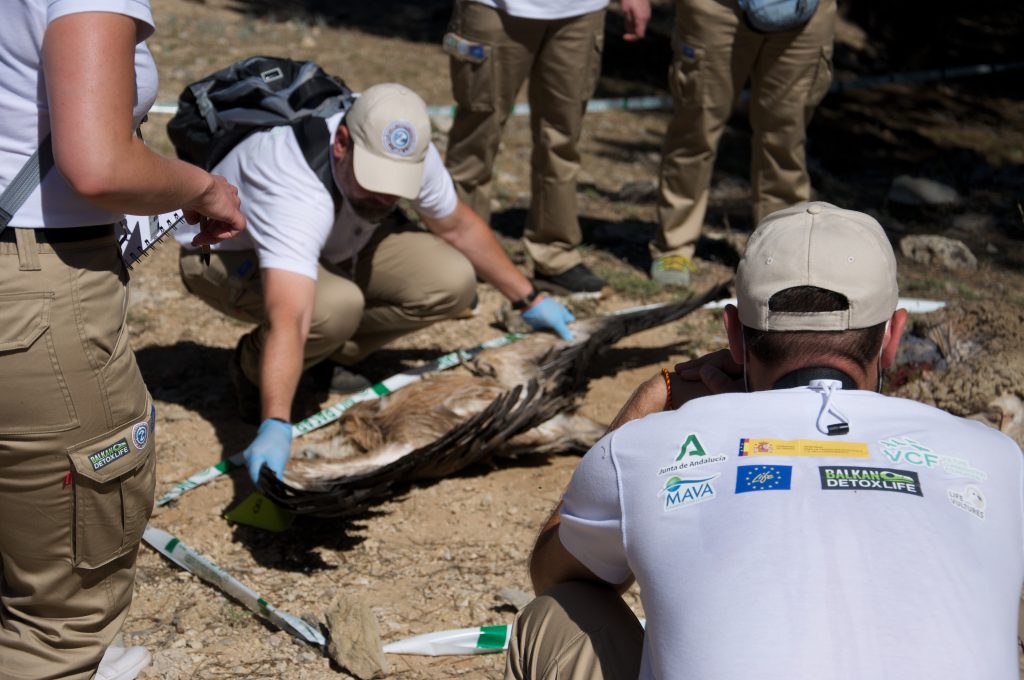
The results are concrete. Standard Operational Protocols for poisoning investigation have been officially adopted in Greece, North Macedonia and Albania. National anti-poisoning road maps have been reinforced in Bulgaria and Greece, adopted in Albania and submitted for adoption in North Macedonia and Bosnia and Herzegovina. Croatia integrated its work into a broader National Action Plan against Wildlife Crime. And 576 law enforcement professionals have been trained across 21 national courses, which were delivered by graduates of the Wildlife Crime Academy, who are now certified trainers in their own countries. Over 100 prosecutors and judges have received targeted training too, tackling the courtroom gap that has long let offenders walk free.
The preliminary findings are encouraging. Since the project began, investigations into poisoning incidents have increased by approximately 50 per cent, while documented poisoning incidents across the Balkans have fallen by roughly 40 per cent. We are seeing real signs, perhaps for the first time, that stronger enforcement is beginning to work as a real deterrent.
– Uroš Pantović, VCF’s BalkanDetox LIFE Project Coordinator
What others can learn
The project’s lessons are transferable well beyond the Balkans. Wildlife poisoning is a pan-European and global problem, and the institutional gaps that allow it to persist are not unique to this region.
What the project demonstrates is that those gaps can be closed, but only through sustained, multi-institutional effort built on trust, shared ownership and collaboration. The case study identifies five core lessons: involve stakeholders from the beginning; build from common ground rather than assigning blame; enhance collaboration through working groups that outlast the project itself; adapt best practices to national circumstances; and train the trainers, so that knowledge builds up and grows rather than disappears when external support withdraws.
The lessons are also timely. As governments gather this week at CMS COP15 in Campo Grande, Brazil, addressing a wide range of conservation priorities, including the illegal killing and poisoning of migratory birds, the Balkans offers a concrete example of what stronger enforcement can look like in practice.
Read the case study
This case study is a part of 25 case studies developed jointly by the IUCN SSC Human-Wildlife Conflict & Coexistence Specialist Group and Food and Agriculture Organization (FAO) of the United Nations with the aim of covering the process projects have taken to understand, plan and address various aspects of a human-wildlife conflict situation.